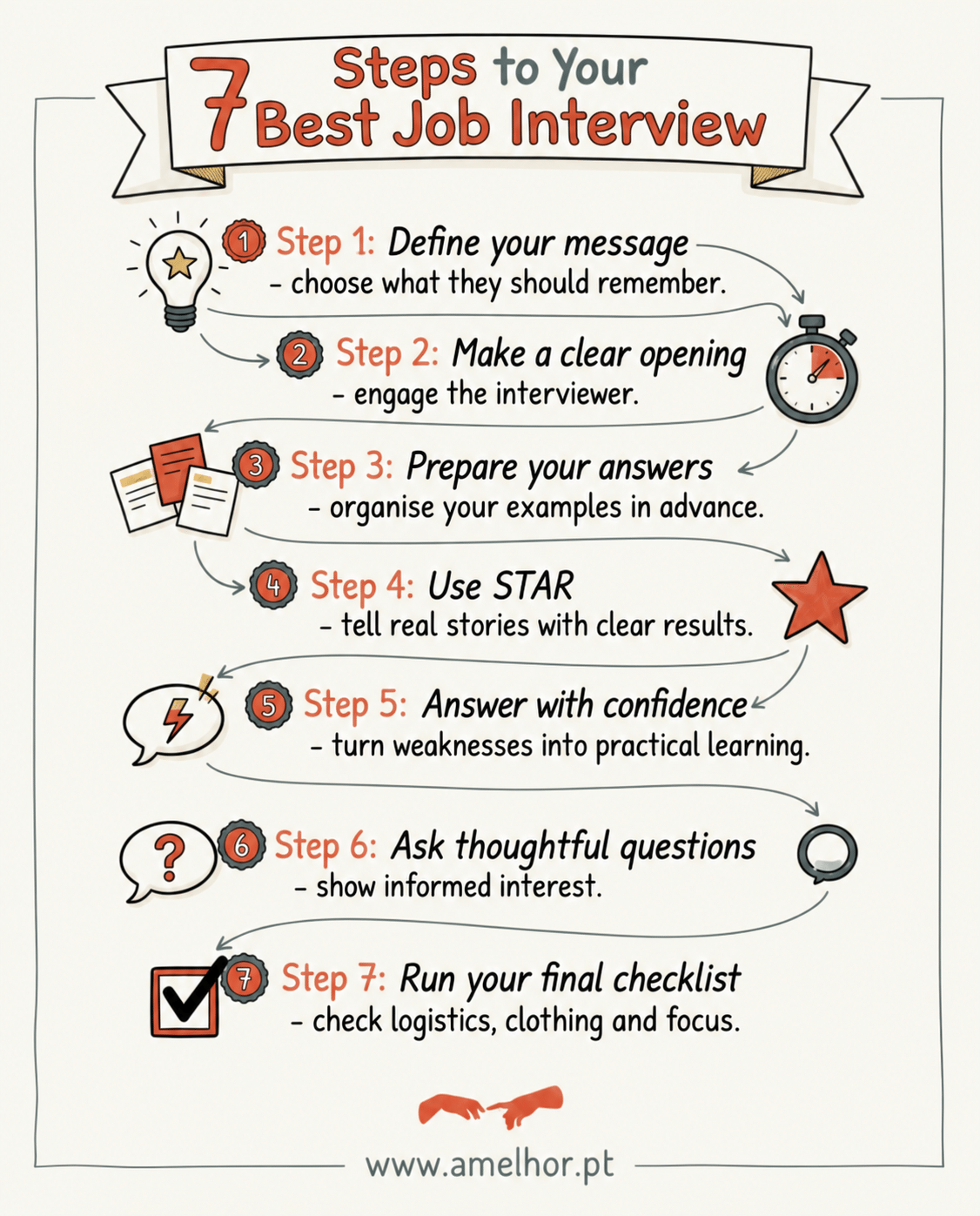
Knowing how to prepare for a job interview helps reduce anxiety, organise your ideas and communicate your skills more clearly. Good preparation includes defining your professional message, practising answers, choosing concrete examples and arranging the practical details.
A 30-second summary
To prepare for a job interview:
- Define your main message.
- Prepare the opening.
- Anticipate likely questions.
- Organise examples with STAR.
- Work through difficult questions.
- Choose questions for the interviewer.
- Run a final checklist.
An interview is more than a sequence of answers. It is an opportunity to communicate a coherent professional message.
1. Define the message you want them to remember
Before the interview, identify two or three ideas you want the interviewer to remember. Connect those ideas to the role’s needs and support them with evidence. Your message might bring together your main field of experience, a relevant skill, a concrete result and your reason for joining the organisation.
For example:
A professional with experience of managing complex projects, coordinating different teams and delivering work to demanding deadlines.
Let this message emerge naturally in your introduction, your professional examples and your explanation of why the role interests you. A coherent message helps the interviewer connect separate answers and understand the value you offer.
2. Make a clear start to the interview
The first few minutes help set the tone. Aim to communicate preparation, interest and clarity through your own words and a natural manner.
A short introduction should answer three questions: which part of your background is most relevant, which skills connect most closely to the role, and why this opportunity makes sense.
A very long opening can lose the interviewer’s attention. An extremely short one may leave your value unexplained. About one to two minutes gives you space to introduce your background and leave room for the conversation.
3. Prepare your answers in advance
Preparing answers means organising ideas and selecting examples so that nerves do not push the most important points out of reach. Keep brief prompts you can adapt as the conversation develops.
Common questions cover your professional background, your interest in the role, your strengths, a difficult challenge, your reasons for changing jobs, how you handle pressure or conflict, and your most significant result.
For each question, prepare the essential points and one suitable example. Read the job description again. Repeated or highlighted requirements often indicate the skills the interviewer will explore. Practise aloud so that you hear where an explanation needs more clarity.
4. Use the STAR method
The STAR method helps turn vague claims into specific examples that are easy to follow. It has four elements:
Situation
The context in which your example took place.
Task
The responsibility or challenge you faced.
Action
The decisions you made and the steps you took.
Result
The concrete outcome of your contribution.
An important project was behind schedule and involved several departments. I was responsible for reorganising the work and recovering the timetable. I created a weekly plan, clarified responsibilities and introduced short progress meetings. The project finished within the revised deadline, with fewer errors in the final stage.
STAR is useful for questions about leadership, problem-solving, teamwork, conflict, objectives and change. Where possible, include real evidence such as time saved, fewer errors, better service or a completed project. Use figures only when you can support them.
5. Prepare for difficult questions
Some questions create more anxiety because they seem to expose weaknesses. Preparation helps you respond honestly and show how you take responsibility for your development.
An answer about weaknesses can include a genuine difficulty, what you learn from it, the action you take and the progress you can already show.
For example:
Under heavy pressure, I used to take on too many tasks. To address that, I started using a priority matrix and set specific points to delegate work and check progress.
The answer acknowledges the difficulty and explains a practical response. The article on the weaknesses interview question develops this approach. A short pause to organise an answer is also acceptable when a question catches you by surprise.
6. Choose questions to ask the interviewer
Your questions show preparation, interest and an ability to assess the opportunity. Useful options include:
- What are the main priorities for this role in the first few months?
- How is success assessed?
- What are the team’s biggest challenges at present?
- How does this role work with other departments?
- What distinguishes strong performers in this organisation?
- What are the next stages of the recruitment process?
Adapt your questions to what has already been discussed. Asking for information that the interviewer has just explained can suggest that you missed it. Contract terms matter too; the right moment depends on the stage of the process and how the organisation conducts the interview.
7. Run a checklist before the interview
A final checklist reduces avoidable distractions and helps you focus on the conversation. Preparation includes the practical conditions in which you listen and respond.
An interview in person
- Confirm the address, route and expected travel time.
- Keep the contact person’s name and details accessible.
- Choose clothing suitable for the organisation.
- Have your CV available as a file or a link you can share.
- Bring a notebook and pen.
- Prepare your portfolio or other relevant documents, where required.

An online interview
- Test the internet connection, camera and microphone.
- Check the platform and the name displayed on your profile.
- Review lighting and camera framing.
- Turn off notifications.
- Have an alternative contact method ready if the technology fails.
Include rest, food and a few free minutes before the appointment. Starting in a rush increases nerves and makes concentration harder. The interview preparation resources offer further support.
How to prepare for a job interview with greater confidence
An interview can still feel stressful after many years of professional experience. Preparation reduces uncertainty and gives you a more reliable foundation for explaining your work.
A project manager with more than 15 years of experience shared this feedback after using the Quick Prep Kit:
“The key questions and sample answers helped me structure what I wanted to say and gain much more confidence. The checklist and techniques for managing nerves also made a difference. Thanks to this preparation, I felt much more confident and secured the job I was applying for.”
Confidence also develops through preparation, organised examples and a clear sense of the message you want the interviewer to remember.
Frequently asked questions about interview preparation
How much time do I need to prepare?
Where possible, start a few days before the interview. That gives you time to research the organisation, study the role, select examples and practise without adding last-minute pressure.
Should I memorise my answers?
Prepare prompts, examples and main messages. A fixed script can sound artificial and make it harder to respond when the conversation changes direction.
How can I manage nerves?
Early preparation, spoken practice, slow breathing and arriving a few minutes before the appointment can help. Some nervousness is natural.
What if I cannot answer immediately?
Take a brief pause to organise the idea. If you lack direct experience, explain a similar example or how you would approach the situation. Be clear about which is real experience and which is your proposed approach.
What should I ask at the end?
Ask about the role’s priorities, the team’s challenges, success criteria and the next stages of the process.
Prepare your next step
Choose the step that needs most attention before your next interview, then practise it aloud using one real example. The free e-book below can help organise that work. For guided practice across the full process, explore The Best Job Interview programme.